
By Wen Luo, Attorney at Law · Reviewed November 2, 2026
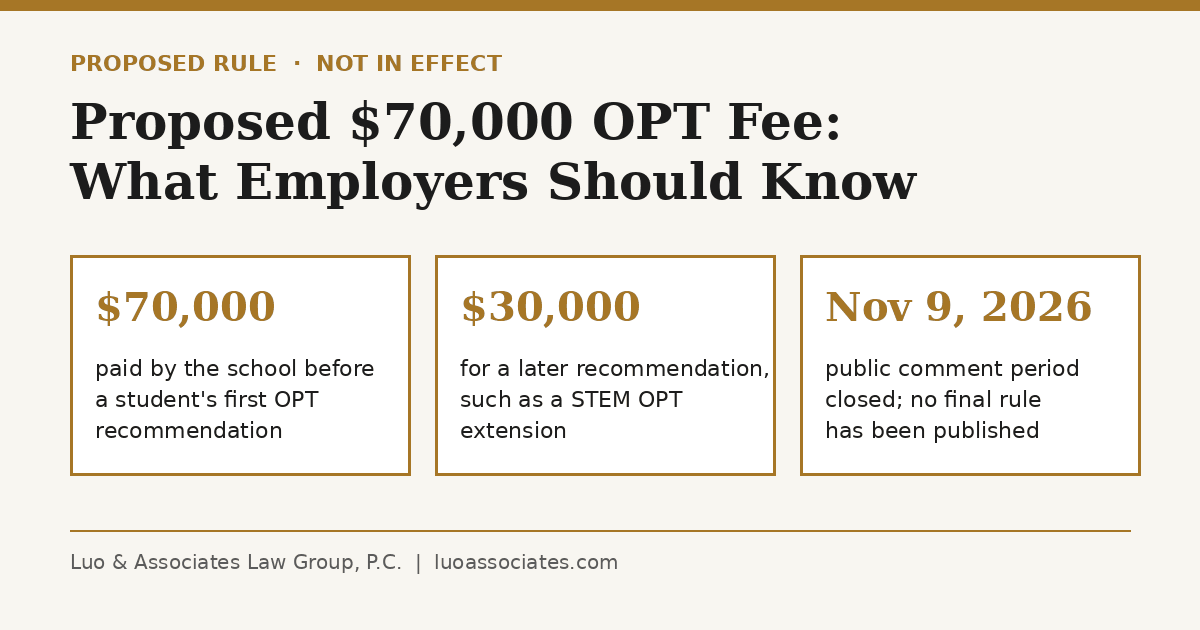
On October 8, 2026, the Department of Homeland Security proposed a $70,000 fee that a school would have to pay before recommending an F-1 student for Optional Practical Training (OPT), and a $30,000 fee for any later OPT recommendation, such as a STEM OPT extension. It is a proposal, not a rule: nothing changes for your OPT employees today, and under the proposed text the fees would apply only to OPT recommendations dated 60 or more days after a final rule is published. The public comment period closed on November 9, 2026. Nothing changes unless DHS publishes a final rule.
Below I explain what the proposal says, what it does not change, and what I would do now if your company employs, or plans to hire, F-1 graduates.
What DHS Proposed
The proposed rule, Optional Practical Training Fees (91 FR 64566), would add a new paragraph (i) to 8 CFR 214.13. Under the proposed text:
- Who pays: the SEVP-certified school, not the employer or the student. The school must pay before its designated school official (DSO) recommends the student for OPT, and USCIS could not approve the student’s OPT work permit if the fee was not paid.
- How much: a one-time $70,000 fee the first time a student is recommended for OPT, and $30,000 for a later OPT recommendation for a student whose school already paid the $70,000 fee. DHS’s cost estimate applies the $30,000 fee to STEM OPT extensions.
- When: only for DSO recommendations dated on or after 60 days after the final rule is published. There is no final rule yet.
- Refunds: SEVP could refund a school case by case only before the work permit is issued; once it is issued, the fee is not refundable.
Current Rules vs. the Proposal
| Today (8 CFR 214.2(f)) | If finalized as proposed | |
|---|---|---|
| OPT fee paid by the school | None | $70,000 before the first OPT recommendation |
| STEM OPT extension | 24 months, with E-Verify, Form I-983 and reporting duties for the employer | Same duties, plus a $30,000 fee the school pays before recommending the extension |
| Who decides whether to recommend OPT | The student’s DSO | The DSO, and only after the school pays |
| Effective date | In effect | 60 days after a final rule (none yet) |
What Does Not Change
The proposal is about fees. The rules employers already follow stay in place:
- STEM OPT employer duties (8 CFR 214.2(f)(10)(ii)(C)): you must be enrolled in E-Verify and in good standing, have an EIN, sign the Form I-983 training plan, offer duties, hours and pay commensurate with similarly situated U.S. workers (at least 20 hours a week), not replace a U.S. worker, report a termination or departure to the school within five business days, and sign the 12-month and final evaluations.
- Unemployment limits (8 CFR 214.2(f)(10)(ii)(E)): 90 days during post-completion OPT, and 150 days in total for a student who receives the STEM extension.
- Cap-gap protection (8 CFR 214.2(f)(5)(vii)): when you file a timely, nonfrivolous cap-subject H-1B change-of-status petition for an F-1 student, the student’s status and OPT work authorization are extended automatically until April 1 of the fiscal year requested, or the petition’s start date if earlier. For a fiscal year 2028 petition, that is April 1, 2028 at the latest. The extension ends if the petition is rejected, denied, revoked or withdrawn.
What I Would Do Now as an Employer
- List your F-1 employees and their OPT end dates. Note who will need a STEM OPT extension in 2027, since a recommendation dated after a final rule takes effect would carry the proposed fee for the school.
- Decide early who you will register in the next H-1B lottery. An H-1B petition with a cap-gap extension is the usual bridge out of OPT. My H-1B fee is listed on the fees page, and I explain timelines for changing employers in H-1B transfer costs and timeline.
- Keep STEM OPT paperwork clean. A missed five-day departure report or an outdated Form I-983 is a compliance problem today, whatever happens to the fee.
- Be careful what you tell candidates. How schools would respond to the fee is not yet known, so avoid promising anything about who will pay or whether a school will recommend OPT.
- Watch for a final rule. The comment period closed on November 9, 2026. Under the proposed text, the fees would apply only to OPT recommendations dated 60 or more days after a final rule is published, so a final rule would come first. Any further action will appear on the Federal Register page.
A Related Proposal: The 60-Day Grace Period
On September 11, 2026, DHS also proposed removing the discretionary grace period of up to 60 days (8 CFR 214.1(l)(2)) that certain nonimmigrant workers, including H-1B workers, can receive after their employment ends. Comments are due November 10, 2026. If it is finalized, a laid-off worker would have less time to find a new sponsor, which matters if you plan to hire H-1B workers from other companies.
Frequently Asked Questions
Does my company have to pay the $70,000 OPT fee?
Not under the proposed text. It places the fee on the SEVP-certified school, which must pay before its DSO recommends the student for OPT.
Does the fee apply to students already on OPT?
The proposal ties the fee to DSO recommendations dated 60 or more days after a final rule. A current OPT employee who later needs a new recommendation, such as for a STEM OPT extension, could be affected if that recommendation falls after the effective date.
Can we still use cap-gap to keep an OPT employee working until H-1B starts?
Yes. The cap-gap rule in 8 CFR 214.2(f)(5)(vii) is not part of the proposal. It applies when you timely file a nonfrivolous cap-subject H-1B petition requesting a change of status.
If you are planning H-1B registrations for OPT employees or want to review your STEM OPT compliance, schedule a consultation. I personally review every case.
Sources (checked November 2, 2026; status rechecked November 9, 2026): 91 FR 64566 (Oct. 8, 2026); 91 FR 57807 (Sept. 11, 2026); 8 CFR 214.2(f)(5)(vii), (f)(10)(ii)(C) and (f)(10)(ii)(E) (eCFR, current as of Oct. 29, 2026); USCIS, STEM OPT (updated Jan. 30, 2026). This article is general information, not legal advice for your situation.
About the Author

Wen Luo, JD, is the managing attorney of Luo & Associates Law Group, P.C. in New York, which she founded in 2018. She has more than 10 years of experience in U.S. immigration law and is a member of the American Immigration Lawyers Association (AILA).
Her practice focuses on employment-based immigration, including H-1B, L-1 (including L-1A/EB-1C for multinational companies), O-1, EB-1, EB-2 and EB-3 petitions, adjustment of status (I-485) and naturalization. She works with clients in English and Chinese.