
If you are hiring someone who already holds H-1B status in the United States, you usually do not need a new lottery selection. You file a new Form I-129 petition as the new employer, and your new hire can generally start working for you once USCIS receives a properly filed petition. With premium processing, USCIS takes action within 15 business days of filing.
What an “H-1B transfer” actually is
There is no separate transfer form. The new employer files its own Form I-129 asking USCIS to approve a change of employer. According to USCIS, a worker who was previously counted toward the H-1B cap does not become subject to the cap again during the same H-1B validity period. The exception: a worker moving from cap-exempt employment (for example, at a university) to a cap-subject employer needs a new registration and selection.
For the differences between a transfer, an amendment and an extension, see H-1B Transfer vs. Amendment vs. Extension.
When your new hire can start: H-1B portability
Under USCIS’s H-1B portability guidance, the worker may begin working for the new employer as soon as the employer properly files a non-frivolous Form I-129, or on the requested start date, whichever is later (8 CFR 214.2(h)(2)(i)(H)). To qualify, the worker must not have worked without authorization since their last admission, and the petition must be filed before their authorized H-1B stay expires.
If the worker was laid off, fired or quit, USCIS allows up to 60 consecutive days, or until the end of the authorized validity period if sooner, to find new employment, change status or leave the country. The grace period is available once per authorized validity period (8 CFR 214.1(l)(2)). A common, avoidable problem is starting the paperwork late and filing after that window closes.
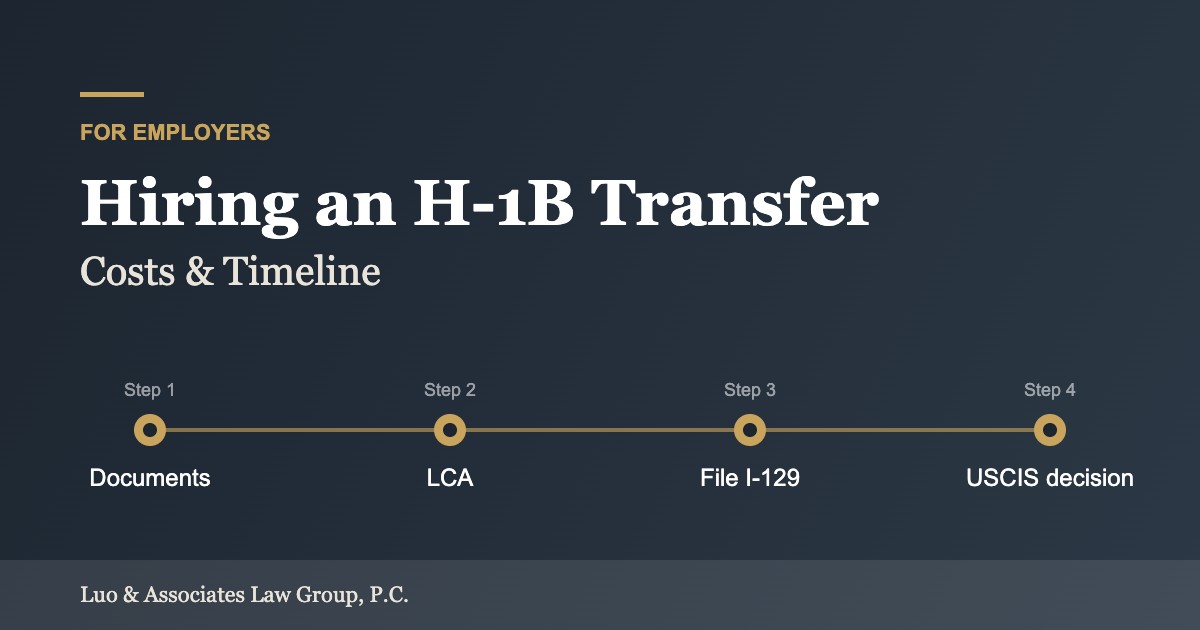
Timeline
| Step | What happens |
|---|---|
| Collect documents and job details | Offer letter, job duties, worker’s current approval notice, I-94 and recent pay stubs |
| Labor Condition Application (LCA) | Certified by the Department of Labor before the I-129 is filed, usually within 7 working days (20 CFR 655.730). The LCA notice must be posted for a total of 10 days (20 CFR 655.734). |
| File Form I-129 | The worker can usually start under portability once USCIS receives it |
| USCIS decision with premium processing | Action within 15 business days |
| USCIS decision without premium processing | Varies by case and service center |
Costs the employer pays
Government fees for a change-of-employer H-1B petition, from USCIS’s Form G-1055 fee schedule and its H and L filing fee page (both updated Sept. 9, 2026):
| Fee | Amount | When it applies |
|---|---|---|
| Form I-129 filing fee (H-1B) | $780 paper / $730 online; $460 for small employers (25 or fewer full-time equivalent employees) and nonprofits | Every petition |
| Asylum Program Fee | $600; $300 for small employers; $0 for nonprofits | Every Form I-129 |
| ACWIA fee | $1,500 or $750, depending on the number of workers you employ | Change of employer petitions, unless you are an exempt organization such as a university |
| Fraud Prevention and Detection Fee | $500 | Required when employing an H-1B worker who currently works for another petitioner |
| Public Law 114-113 fee | $4,000 | Employers with 50+ U.S. employees, more than half in H-1B or L status (petitions filed through Sept. 30, 2027) |
| Premium processing (Form I-907, optional) | $2,965 since March 1, 2026 (Federal Register) | Only if you want a decision within 15 business days |
A transfer petition for someone already in H-1B status is generally not a new cap-subject petition. For a proposal that would add a fee to new cap-subject petitions, see the proposed $103,265 H-1B fee.
The $100,000 payment. USCIS states that on June 8, 2026 a federal court vacated the agency guidance implementing the $100,000 payment for certain H-1B petitions, and on July 24, 2026 the First Circuit denied the government’s request to stay that order. USCIS says it will comply with the order while DHS considers next steps, and that it still plans to collect the payment if the order is later lifted. Check the USCIS H-1B page for the current status before you file.
What I check before we file
- Status history. Recent pay stubs and I-94 records show whether the worker has stayed in status. Any unauthorized employment since the last admission affects portability.
- The job. The new role must qualify as a specialty occupation, and the LCA must match the job, wage and worksite.
- Worksites. Every place the worker will work, including a home office, must be covered by the LCA.
- Travel plans. International travel while the petition is pending can complicate the case, especially if the worker needs a new visa stamp.
Frequently asked questions
Does the worker need to be selected in the lottery again?
Not if they were previously counted toward the cap. A worker moving from cap-exempt to cap-subject employment is the main exception.
Can the worker keep their current job while the new petition is pending?
Yes. Portability covers both new and concurrent employment (8 CFR 214.2(h)(2)(i)(H)), so the worker can stay with the current employer until they are ready to switch.
What happens if the new petition is denied?
Per USCIS, work authorization based on portability ends when the petition is denied. The worker may keep working for the previous employer only if that prior authorized employment is still valid. Plan for this before the worker resigns.
How fast can we get a decision?
With premium processing ($2,965), USCIS takes action within 15 business days of receiving the petition.
Next step
If you are hiring someone on an H-1B, I can review the worker’s status documents and give you a fixed fee and timeline before you make the offer. See my H-1B services or contact me.
This article is general information, not legal advice for your situation.
About the Author

Wen Luo, JD, is the managing attorney of Luo & Associates Law Group, P.C. in New York, which she founded in 2018. She has more than 10 years of experience in U.S. immigration law and is a member of the American Immigration Lawyers Association (AILA).
Her practice focuses on employment-based immigration, including H-1B, L-1 (including L-1A/EB-1C for multinational companies), O-1, EB-1, EB-2 and EB-3 petitions, adjustment of status (I-485) and naturalization. She works with clients in English and Chinese.