
By Wen Luo, Attorney at Law · Reviewed November 18, 2026 · Sources checked November 18, 2026
On November 17, 2026, the Department of Labor proposed a rewrite of the PERM labor certification rules at 20 CFR part 656 (91 FR 73916). It is a proposed rule, not law: every PERM application filed today is still governed by the current rules. Comments are due January 19, 2027.
At a glance
- Status: notice of proposed rulemaking (RIN 1205-AC29, docket ETA-2026-0133). Nothing changes until DOL publishes a final rule with an effective date.
- Schedule A: DOL proposes to stop administering it, so those occupations would need a full labor market test.
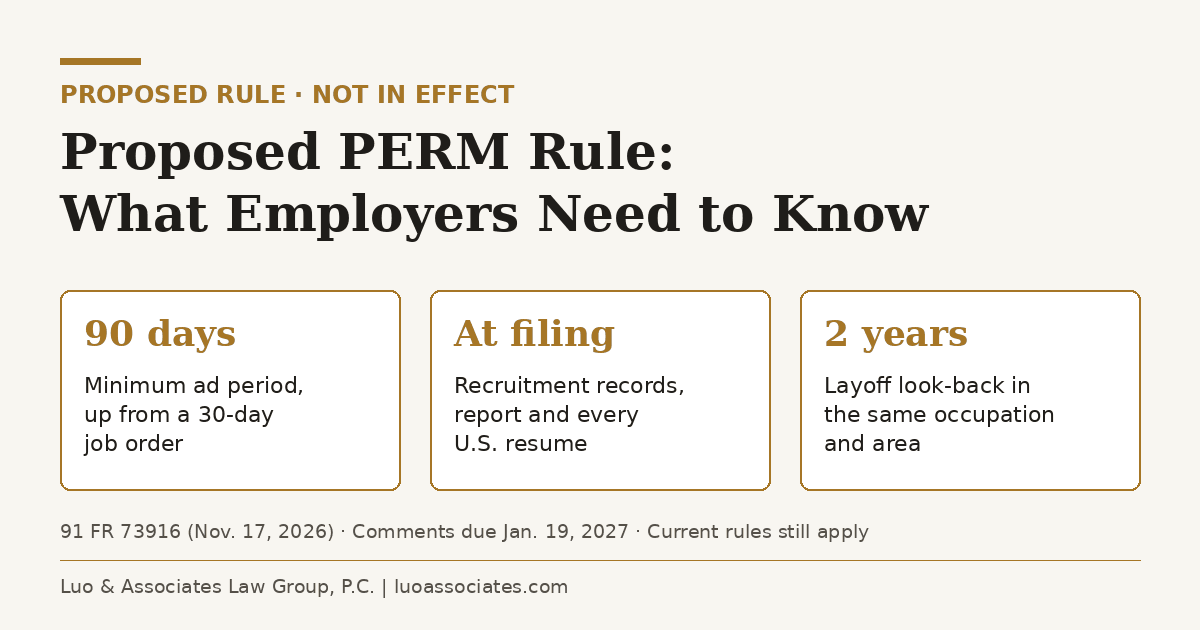
- Recruitment: five required steps, matched to how you recruit for similar non-PERM jobs, with ads active for at least 90 calendar days.
- Evidence at filing: recruitment records, the recruitment report and every U.S. applicant’s resume would be filed with the application, not only in an audit.
- Layoffs: no layoffs in the same or similar occupation and area within 2 years before filing, with duties that continue after filing.
Current Rules vs. the Proposal
| Topic | Current rule (still in effect) | Proposed rule (not in effect) |
|---|---|---|
| Schedule A | Listed occupations skip the labor market test | DOL would stop administering Schedule A |
| Recruitment for professional jobs | 30-day SWA job order, two Sunday newspaper ads and three additional steps from a list of ten | SWA job order, employer website, job search website(s), social media where customarily used, and a job fair, campus event or placement office |
| Benchmark | None | Recruit the way you customarily do for the same occupation when no PERM is involved |
| Ad length | Job order for 30 days | At least 90 calendar days, or longer if that is your usual practice |
| Timing | Mandatory steps at least 30 and no more than 180 days before filing | Ads completed 30 to 60 days before filing; file within 30 days after recruitment ends |
| Wage in ads | Not required | The offered wage or wage range in the application and the ads |
| Recruitment evidence | Kept on file for an audit | Filed with the application |
| Layoffs | Notify and consider laid-off workers if a layoff occurred within 6 months of filing | No layoffs in the same or similar occupation and area within 2 years before filing; duties continue until the I-140 is decided |
What Would Change for Employers
1. Recruitment that mirrors your normal hiring
Proposed § 656.17(b) replaces the newspaper-based process with five steps for every job: a job order with the state workforce agency; an ad on the web page you customarily use to recruit for the same occupation (or a conspicuous post on all your business websites if you don’t recruit there); at least one outside job search website, and every site you customarily use; every social media platform you customarily use for the same occupation; and a job fair, on-campus event or school placement office while the job order is active. The theme is consistency: the PERM search may not be thinner than the search you would run for the same role without PERM.
2. A longer, tighter timeline
The ads in steps one through four would have to run at least 90 calendar days, or longer if you customarily advertise similar jobs longer (proposed § 656.17(c)). They must end no more than 60 and no less than 30 calendar days before you expect to file (§ 656.17(d)), and the complete application must be filed within 30 calendar days after recruitment ends (§ 656.10(b)). DOL reads these together: finish recruitment 30 to 60 days before the expected filing date, then file 1 to 29 days after the last recruitment activity ends.
3. Evidence filed up front
Today, the employer attests to its recruitment and produces documents if audited. Under proposed § 656.10(a), the application would include the prevailing wage determination, a copy of the notice of filing, all recruitment records, a signed recruitment report and copies of the resumes or applications of every U.S. worker who applied. The report would list each ad’s location, dates and the platform’s confirmation number or receipt (§ 656.17(f)).
4. A two-year layoff look-back that continues after filing
Proposed § 656.13(e) bars filing if you laid off U.S. workers in the same or similar occupation (same SOC code or a substantially comparable position) in the area of intended employment within 2 years before filing. If such a layoff happens after filing and before the I-140 is approved (or the case is denied or withdrawn), you would have to notify DOL, and USCIS if the I-140 is pending, within 5 business days, and offer the job to the laid-off workers. Proposed § 656.13(f) applies a similar bar when the sponsored worker is placed with another company that laid off workers in the same or similar occupation.
5. Assurances with real consequences
The employer would assure, under penalty of perjury, that U.S. applicants are rejected only for lawful, job-related reasons, and that no qualified U.S. worker is rejected based on cost, including differences in pay and benefits (proposed § 656.13(a)). “The candidate asked for more than our budget” would not be a lawful reason. The notice of filing could be posted electronically on a website employees customarily use, and would also be required at a third-party worksite where the worker will be placed (proposed § 656.14).
When It Could Take Effect
Only after DOL reviews comments and publishes a final rule. DOL proposes a 90-day transition: a 60-day delayed effective date plus 30 more calendar days. The final rule could differ from the proposal, or never be issued.
What I Recommend Employers Do Now
- Keep current cases moving. Recruitment and filings under today’s rules remain valid. Pausing a case to wait for the final rule only delays the worker’s priority date.
- List your in-flight cases by expected filing date. If a final rule arrives, the filing date is likely to decide which rules apply.
- Write down how you recruit for non-PERM roles. Which sites and platforms, how long ads run, who interviews. The proposal measures PERM recruitment against that practice.
- Check whether you can pull two years of layoff data by SOC code and work location, including for client sites where you place workers.
- Consider commenting by January 19, 2027. DOL estimates a two-Sunday newspaper ad at $1,362 and asks whether that figure is too high or too low. Real cost data from employers is the kind of comment that can matter.
If you are deciding between EB-2 and EB-3 for a sponsored employee, see my EB-2 and EB-3 green card services and my guide to the EB-2 to EB-3 downgrade.
Frequently Asked Questions
Do the new PERM rules apply to applications filed now?
No. The November 17, 2026 document is a proposed rule with no legal effect. The current rules apply until DOL publishes a final rule and it takes effect.
Would nurses and physical therapists still be exempt from recruitment?
Not under the proposal. DOL proposes to stop administering Schedule A, so employers of those occupations would run the full PERM process. Today, Schedule A still applies.
How much longer would a PERM case take?
The proposal raises the minimum ad period from a 30-day job order to at least 90 calendar days, and adds a fixed window before filing. How much later the filing date moves depends on the final rule and your own recruitment practice.
How do I comment?
Anyone can submit a comment on regulations.gov under docket ETA-2026-0133 by January 19, 2027.
Planning a green card for an employee?
Send me the role, the location and when you want to start, and I will map out the PERM timeline under the current rules. See my fees.
A call about my services and fees is free. A legal consultation on your specific case is a paid service.
Sources (checked November 18, 2026): DOL, Modernizing the Labor Market Test and Improving Protections for U.S. Workers in the PERM Immigrant Visa Program, 91 FR 73916 (Nov. 17, 2026), including proposed §§ 656.10, 656.13, 656.14 and 656.17; current 20 CFR 656.17 (eCFR, up to date as of Nov. 16, 2026). This article is general information, not legal advice for your situation.
About the Author

Wen Luo, JD, is the managing attorney of Luo & Associates Law Group, P.C. in New York, which she founded in 2018. She has more than 10 years of experience in U.S. immigration law and is a member of the American Immigration Lawyers Association (AILA).
Her practice focuses on employment-based immigration, including H-1B, L-1 (including L-1A/EB-1C for multinational companies), O-1, EB-1, EB-2 and EB-3 petitions, adjustment of status (I-485) and naturalization. She works with clients in English and Chinese.