
By Wen Luo, Attorney at Law · Reviewed November 23, 2026 · Sources checked November 23, 2026
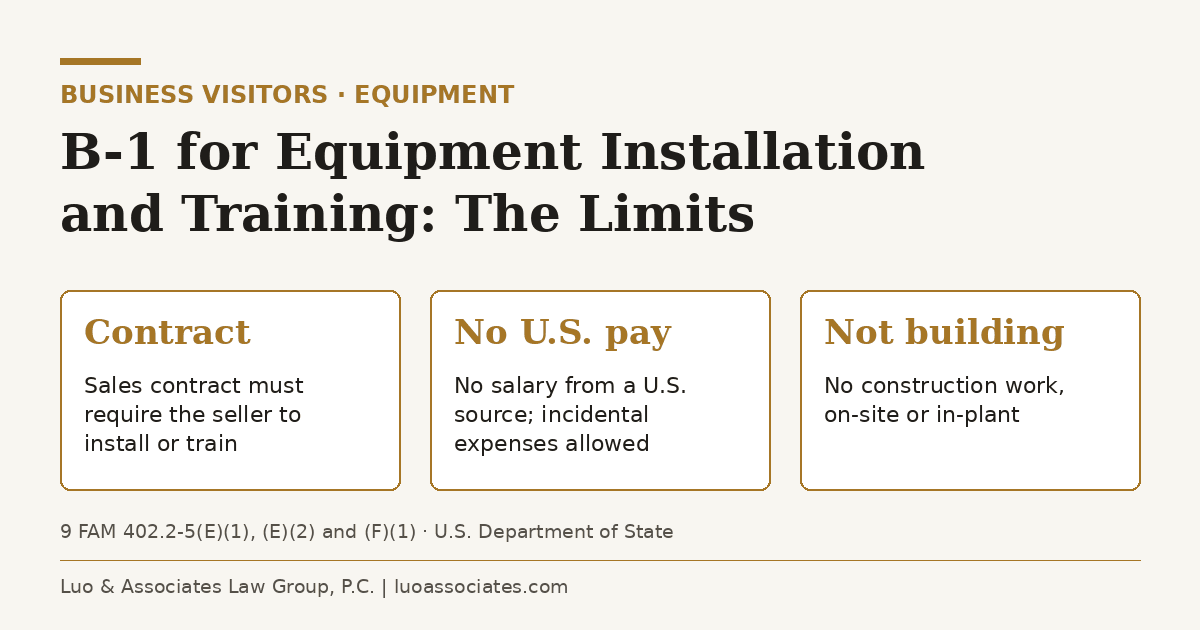
A technician can sometimes come to the United States on a B-1 visa to install, service or repair commercial or industrial equipment bought from a company abroad, or to train U.S. workers to do that work. Three conditions apply: the sales contract must require the seller to provide those services, the technician must have unique knowledge essential to that obligation, and the technician must receive no pay from a U.S. source (9 FAM 402.2-5(E)(1)). The B-1 does not cover building or construction work, even inside the plant. If the work falls outside these limits, the person needs a work visa.
At a glance
- Possible on a B-1: installing, servicing or repairing equipment bought from a company abroad, and training U.S. workers to do so, when the sales contract requires it.
- Not on a B-1: building or construction work, production work, or running the plant.
- Pay: no salary from a U.S. source. A U.S. company may cover reasonable incidental expenses.
- Check the contract first: if it does not require the seller to install or train, this B-1 basis is not available.
Which Activities Fit a B-1
| What the person will do | B-1? | Key point |
|---|---|---|
| Install, service or repair equipment your company bought from a company outside the U.S. | Possible | The sales contract must require the seller to provide the service; the person needs unique knowledge and no U.S. pay (9 FAM 402.2-5(E)(1)) |
| Train your U.S. workers to install, service or repair that equipment | Possible | Same conditions as above |
| Build the plant or do construction work, on-site or in-plant | No | The only exception is supervising or training construction workers without doing the construction work (9 FAM 402.2-5(E)(1)) |
| Meet suppliers, negotiate contracts, consult with business associates | Yes | Standard business visitor activities (9 FAM 402.2-5(B)) |
| Production work or managing the plant day to day | No | A work visa is needed, such as the L-1 or H-1B |
The Equipment Installation Rule
The B-1 is generally for business activities other than skilled or unskilled labor, and it is not meant for people who will take up employment in the United States (9 FAM 402.2-5(A)). The State Department lists equipment work as one of the exceptions. A consular officer may issue a B-1 to someone coming to install, service or repair commercial or industrial equipment or machinery purchased from a company outside the United States, or to train U.S. workers to perform those services. Three conditions must all be met (9 FAM 402.2-5(E)(1)):
- The contract requires it. The contract of sale must specifically require the seller to provide the installation, service or training.
- Unique knowledge. The person must have unique knowledge that is essential to the seller’s obligation under the contract.
- No U.S. pay. The person must receive no remuneration from a U.S. source.
In my experience, the contract is where these trips run into trouble. Equipment is often bought on a standard purchase order that says nothing about installation, or installation is listed as a separate service from a U.S. vendor. If you plan to rely on the seller’s technicians, have the installation and training obligation written into the purchase contract before you sign it. Have the technician carry the relevant pages when they travel.
Training U.S. Workers: the Specialized Trainer Category
The Foreign Affairs Manual also describes a “specialized trainer” B-1, in a section last updated on December 4, 2025. It covers a person traveling temporarily to train U.S. workers or transfer knowledge to them. That includes specialized or proprietary techniques, skills or know-how needed for industrial equipment, machinery or processes acquired or sourced from a company outside the United States, in support of a qualifying project. The person must have unique knowledge that is not widely available in the United States, and must receive no remuneration from a U.S. source. The visa is annotated “B-1 SPECIALIZED TRAINER” (9 FAM 402.2-5(E)(2)).
One caution: the public version of the manual does not say what counts as a “qualifying project”; that paragraph is marked unavailable. I would not plan a project around this category alone without discussing it first.
Building the Plant Is Not B-1 Work
The equipment rule does not apply to building or construction work, whether on-site or in-plant. The only exception is a person who supervises or trains other workers doing building or construction work, without doing any of that work themselves (9 FAM 402.2-5(E)(1)). For a new factory, this line matters. A technician who installs a production line bought from your supplier abroad may fit. A crew sent to build the facility does not.
Who Pays: No U.S. Salary
A B-1 visitor may not receive a salary from a U.S. source for services connected with the visit. A U.S. source may provide an expense allowance or reimburse expenses incidental to the temporary stay. These are limited to the actual, reasonable costs of travel and living expenses such as meals, lodging and laundry (9 FAM 402.2-5(F)(1)). In practice, the technician stays on the foreign company’s payroll, and your U.S. company may cover the hotel and meals.
When You Need a Work Visa Instead
If the people coming are your own employees from a parent, subsidiary or affiliate abroad, and they will help run production rather than finish a supplier’s installation, the L-1B is usually the steadier choice. It covers employees with specialized knowledge of the company’s products, equipment, techniques or processes. It requires one continuous year with the company abroad in the last three years (8 CFR 214.2(l)(1)(ii)(A) and (D)). See my L-1 visa services. For engineers you hire who do not work for your company abroad, see my H-1B services. For the full sequence when a company abroad opens a factory, see my visa plan for opening a U.S. plant and hiring international employees in manufacturing.
Frequently Asked Questions
Can our U.S. company pay the technician while they are here?
Not a salary. A U.S. source may cover an expense allowance or reimburse reasonable incidental expenses, such as travel, meals and lodging (9 FAM 402.2-5(F)(1)). The salary should continue to come from the employer abroad.
Our parent company sold us the equipment. Does the rule still apply?
The rule refers to equipment purchased from a company outside the United States under a contract of sale that requires the seller to provide the services. Whether an intercompany transfer fits depends on the documents. If the same people will stay on to help run production, I usually look at the L-1B instead.
Can a technician come to supervise the construction crew?
Supervising or training workers who do building or construction work is the one exception, as long as the person does not do any construction work themselves (9 FAM 402.2-5(E)(1)).
Sending technicians for an installation?
I can review the purchase contract and the planned work before anyone travels. I personally review every case, supported by our paralegal team. See my fees.
A call about my services and fees is free. A legal consultation on your specific case is a paid service.
Sources (checked November 23, 2026): U.S. Department of State, 9 FAM 402.2 (sections 402.2-5(A), (B), (E)(1), (E)(2) and (F)(1)); 8 CFR 214.2(l) (eCFR). Visa decisions are made by consular officers, and the Foreign Affairs Manual can change. This article is general information, not legal advice for your situation.
About the Author

Wen Luo, JD, is the managing attorney of Luo & Associates Law Group, P.C. in New York, which she founded in 2018. She has more than 10 years of experience in U.S. immigration law and is a member of the American Immigration Lawyers Association (AILA).
Her practice focuses on employment-based immigration, including H-1B, L-1 (including L-1A/EB-1C for multinational companies), O-1, EB-1, EB-2 and EB-3 petitions, adjustment of status (I-485) and naturalization. She works with clients in English and Chinese.