
By Wen Luo, Attorney at Law · Reviewed November 6, 2026
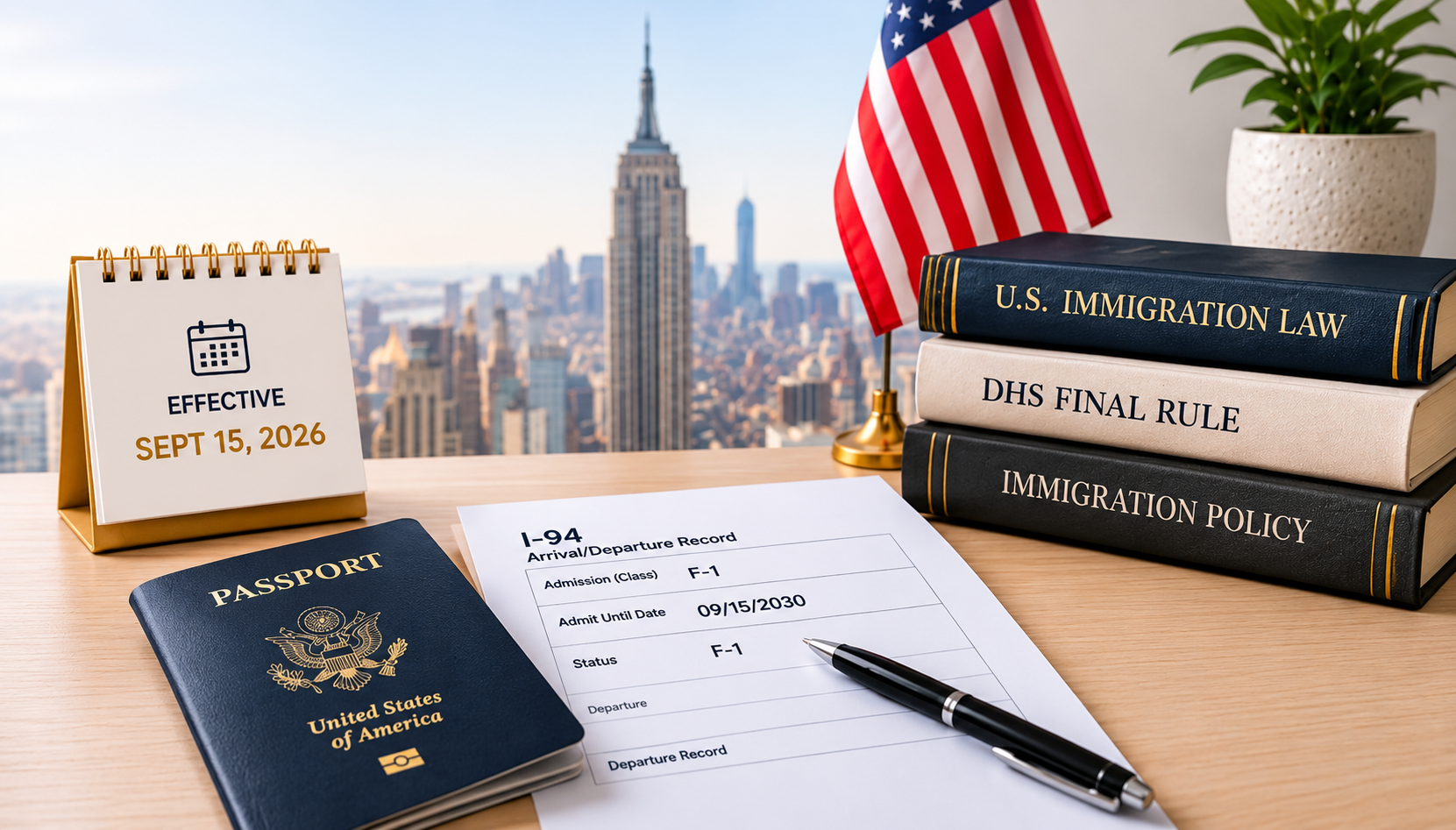
Editor’s Note & Current Legal Status: On September 14, 2026, the U.S. District Court for the District of Massachusetts issued an order under APA § 705 in Presidents’ Alliance v. DHS, No. 1:26-cv-13799, postponing the effective date of the Department of Homeland Security (DHS) final rule. As a result, the rule is not currently in effect, and F-1 students and J-1 exchange visitors currently remain on duration of status (D/S).
Key Takeaways
- Current Legal Status: The DHS final rule published in the Federal Register was postponed on September 14, 2026, under APA § 705 by the U.S. District Court for the District of Massachusetts in Presidents’ Alliance v. DHS, No. 1:26-cv-13799. F-1 and J-1 visa holders currently remain on duration of status (D/S).
- Proposed Scope: If eventually implemented following judicial review, the DHS final rule would eliminate duration of status admission for F-1 visa students, J-1 exchange visitors, and I-visa media representatives, replacing it with fixed periods of stay of up to four years, and reducing the F-1 post-completion departure period from 60 days to 30 days.
- Extension Procedures under Proposed Rule: If the rule takes effect, nonimmigrants needing additional time would be required to file a USCIS extension of stay before their Form I-94 expiration date using Form I-539, and F-1 OPT applicants would file Form I-765. Overstaying past a fixed expiration date would trigger unlawful presence accrual under 8 CFR 214.
- Preserved Categories: H-1B, L-1, O-1, and most other nonimmigrant visa categories are unaffected by this change, and the H-1B cap-gap framework for eligible F-1 students is preserved.
What Was “Duration of Status”?
For decades, certain nonimmigrants admitted to the United States received a designation of “duration of status” (D/S) on their Form I-94, rather than a specific calendar end date. Under this longstanding policy, a visa holder could remain in the United States as long as they maintained the conditions of their nonimmigrant category.
The D/S designation applied most broadly to F-1 visa students, J visa exchange visitors, and I-visa representatives of foreign media. For an F-1 visa student, maintaining status typically meant staying enrolled full-time in a qualifying program. For a J-1 exchange visitor, it meant actively participating in their authorized exchange program.
Under the traditional F nonimmigrant admission process, the Form I-94 showed “D/S” rather than a hard date. This gave schools, Designated School Officials (DSOs), and program sponsors flexibility in managing timelines, but also created ambiguity about exactly when lawful status ended.
The New DHS Final Rule: What’s Changing
The rule is postponed and not in effect. The rest of this section describes what would change if the rule takes effect as written.
The DHS final rule eliminates D/S admission for F, J, and I nonimmigrants and replaces it with fixed periods of stay. This is one of the most significant changes to the F nonimmigrant admission process in recent decades, and it simultaneously ends the longstanding J-1 duration of status framework.
Under the New Rule
Instead of receiving an I-94 stamped “D/S,” F-1 visa students and J-1 exchange visitors would be admitted for the length of their program, not to exceed four years. For F-1 students, that means the program length on Form I-20, up to four years, plus 30-day periods for arrival and departure. I-visa foreign media representatives would be admitted for a fixed period of up to 240 days.
All affected visa holders would receive a Form I-94 with a specific I-94 expiration date. Staying past that date would require a timely extension of stay. Dependents are also covered: F-2 and J-2 visa holders transition from D/S to fixed periods of stay alongside their primary visa holders.
The rule also reduces the F-1 post-completion grace period from 60 days to 30 days, aligning it with the existing J-1 departure period. Under the prior D/S framework, F-1 students had 60 days after completing their program or OPT to depart, change status, or file an extension. If the rule takes effect, F-1 visa holders who were in D/S status on September 15, 2026, would retain their 60-day grace period until they travel internationally and re-enter the United States, at which point the new 30-day period applies.
New Academic Restrictions for F-1 Students
Beyond the admission period changes, the rule would impose new restrictions on academic mobility that would affect a significant subset of F-1 visa students.
- English language training (ELT): Students enrolled in ESL or ELT programs are subject to a 24-month aggregate cap on total admission for that purpose, including breaks and annual vacations. Time spent in ELT before September 15, 2026, does not count toward the limit. Programs in which ELT is embedded within a broader degree pathway are excluded from the cap.
- Public high school: F-1 students at public secondary schools, including charter schools, remain capped at 12 aggregate months of study, including school breaks and annual vacations.
- First-year academic restrictions: F-1 students enrolled below the graduate level may not transfer schools, change their educational objective, or switch majors during their first year of study, unless SEVP approves an exception for extenuating circumstances.
- Educational level restrictions: A student who completes a U.S. program at one educational level generally may not maintain, obtain, or be admitted in F-1 status to pursue another program at the same or a lower educational level.
When Does This Take Effect?
The DHS final rule was published in the Federal Register on July 17, 2026.
However, on September 14, 2026, the U.S. District Court for the District of Massachusetts issued an order under APA § 705 in Presidents’ Alliance v. DHS, No. 1:26-cv-13799, postponing the rule’s effective date pending judicial review. As a result of this ruling, foreign students and exchange visitors currently remain on duration of status (D/S), and DHS continues to administer F and J nonimmigrant admissions under existing duration of status regulations found at 8 CFR 214.2.
The September 14 order was issued in Presidents’ Alliance on Higher Education and Immigration et al. v. U.S. Department of Homeland Security et al., No. 1:26-cv-13799, a lawsuit filed in August 2026 by higher-education and labor organizations. The case is ongoing, and the rule’s status could change.
The complaint alleges that the rule violates the Administrative Procedure Act, arguing that DHS failed to adequately assess costs and benefits, provided an insufficient public comment period, and exceeded its statutory authority. It also seeks vacatur. As of publication, no stay or injunction has been granted, and September 15 remains the operative date. I will update this page if the court’s order or the case changes the rule’s status.
Transition Rules for Current D/S Holders
F and J nonimmigrants who are lawfully maintaining D/S status when the rule takes effect on September 15, 2026, are protected by transition rules and do not need an immediate corrected I-94. These individuals may remain in the United States until the program end date reflected on their Form I-20 or DS-2019, or until September 15, 2030 (four years from the effective date), whichever comes first. For F-1 students in this transition category, the absolute outside date — including the 60-day departure grace that applies to transition holders — is November 14, 2030. The corresponding outside date for J-1 transition holders, who receive a 30-day departure grace, is October 15, 2030.
However, there is one critical exception: any F or J nonimmigrant who travels internationally and re-enters the United States after the rule takes effect would receive a new, fixed-period I-94 at the port of entry. Travel abroad after the effective date would end the D/S transition protection.
One additional accommodation applies to OPT and STEM OPT: F-1 students who were admitted for D/S and timely apply for post-completion OPT or a STEM OPT extension on or before March 18, 2027, do not need to file a separate extension of stay application for their F-1 status.
Separately, DHS has proposed a fee that schools would pay before recommending OPT; see what the proposed $70,000 OPT fee means for employers.
Who Is Affected?
Three categories of nonimmigrants are subject to the new rule:
- F nonimmigrants: F-1 visa students and their F-2 dependents
- J nonimmigrants: J visa exchange visitors (J-1) and their J-2 dependents
- I nonimmigrants: Representatives of foreign media admitted on I visas
Who Is NOT Affected
It is equally important to clarify who this rule does not affect. The following nonimmigrant categories will see no change to their admission process or I-94 terms:
- H-1B specialty occupation workers
- L-1 intracompany transferees
- O-1 individuals of extraordinary ability or achievement
- TN, E-1, E-2, and most other nonimmigrant classifications
These visa holders already receive fixed-period I-94s, so the elimination of D/S does not change anything for them.
Practical Implications: Fixed I-94 Dates and Extensions
Under the new framework, duration of status F-1 visa holders must monitor their I-94 end date with care. When an F-1 student’s fixed period of stay is approaching, they should coordinate with their DSO to determine whether a USCIS extension of stay is needed and file before the current authorized period expires.
Extensions of stay would require filing Form I-539, Application to Extend/Change Nonimmigrant Status. F-1 students filing for OPT or STEM OPT must also file a revised Form I-765, Application for Employment Authorization. USCIS had announced revised editions of both forms for September 15, 2026, but has since archived that announcement as out of date. Check the current edition on each form’s USCIS page before filing.
For J-1 holders, the end of the J-1 duration of status designation creates the same new obligation. Exchange program sponsors would need to update their advising practices so that J-1 participants clearly understand their I-94 end dates and their steps for extending authorized stay. Luo & Associates recommends beginning the extension process at least 90 days before the I-94 expiration date to allow adequate processing time.
H-1B Cap-Gap Protection Preserved
The new rule does not alter the H-1B cap-gap framework. F-1 visa students who are the beneficiaries of a timely filed, non-frivolous, cap-subject H-1B change-of-status petition continue to receive an automatic extension of their F-1 status and any qualifying OPT or STEM OPT employment authorization. Under the current cap-gap structure, that automatic extension runs through April 1 of the relevant fiscal year, or until the H-1B petition’s validity start date, whichever comes earlier.
F-1 students approaching graduation who are weighing their longer-term options in the United States should explore H-1B visa sponsorship as early as possible. The shortened 30-day post-completion grace period makes early planning more important than ever.
What Happens If You Overstay?
Under the prior D/S system, unlawful presence for F-1 students did not begin to accrue until a formal status violation finding was made. The new rule eliminates that protection.
Once in effect, unlawful presence begins to accrue the day after the F-1 visa fixed period of stay expires, if no timely extension has been filed. Per USCIS policy, the consequences are serious:
- Accruing 180 days or more of unlawful presence triggers a 3-year bar from re-entering the United States
- Accruing one year or more triggers a 10-year bar
- These bars take effect upon the individual’s departure or removal from the country
Transitioning to employer-sponsored status before a duration of status period ends is far more straightforward than resolving unlawful presence as an F-1 student after the fact.
For Employers: F-1 OPT and J-1 Exchange Workers
Employers who hire F-1 visa OPT workers or J visa exchange visitors have meaningful new I-9 compliance obligations under this rule. Previously, an I-94 reading “D/S” created ambiguity around when reverification was required. Under the new framework, all I-94s for F and J nonimmigrants will carry specific expiration dates, making reverification timelines clearer and far more consequential.
What Employers Should Do Now
- Audit all I-9 records for employees currently on F-1 OPT, STEM OPT, or J-1 status
- Set reminders to reverify work authorization before EAD cards and I-94 expiration dates pass
- Confirm that HR teams understand the relationship between OPT program end dates and I-9 reverification requirements
- Consult with immigration counsel before September 15 to verify that current I-9 records are fully compliant
Employers considering long-term sponsorship for F-1 or J-1 workers through the H-1B visa program can contact Luo & Associates to discuss H-1B sponsorship, visa transitions and I-9 compliance planning. A call about my services and fees is free; a legal consultation on your specific case is a paid service.
USCIS Deference to Prior Approvals: Proposed Change
Today, 8 CFR 214.1(c)(5) generally provides that USCIS gives deference to a prior approval involving the same facts when it decides a request to extend a petition or stay. On October 14, 2026, DHS proposed removing that provision. It is a proposal, not a final rule, and comments are due November 13, 2026. If it is finalized, an extension request could be reviewed without deference to an earlier approval, so document eligibility fully each time.
What Should You Do Now?
The rule is postponed for now, but its status could change while the case continues. If you are a duration of status F-1 visa holder, a J-1 exchange visitor, or an employer with F or J nonimmigrant workers on staff, understanding your I-94 end date, your extension options, and your compliance obligations is essential.
For official guidance, the Study in the States Quick Facts page published by DHS provides a student-facing overview of the new requirements. For legal strategy tailored to your specific situation, Luo & Associates is available to help.
I help students, exchange visitors and employers plan around changes like this one, and I personally review every case. Schedule a consultation. A call about my services and fees is free; a legal consultation on your specific case is a paid service.
Disclaimer: The information provided in this article is for marketing and informational purposes only and does not constitute legal advice. Prior results do not guarantee a similar outcome. Immigration law is complex and constantly evolving. Each case is unique, and its success depends on various factors, including the specific facts, applicable laws, and the discretion of immigration authorities. You should consult with a qualified immigration attorney for advice regarding your individual circumstances.
Sources
- U.S. Department of Homeland Security. Establishing a Fixed Time Period of Admission and an Extension of Stay Procedure for Nonimmigrant Academic Students, Exchange Visitors, and Representatives of Foreign Information Media. Federal Register, July 17, 2026. federalregister.gov
- U.S. Department of Homeland Security, Study in the States. Final Rule: Establishing a Fixed Time Period of Admission and an Extension of Stay Procedure — Quick Facts. July 20, 2026. studyinthestates.dhs.gov
- U.S. Citizenship and Immigration Services. USCIS to Publish New Editions of Form I-539 and Form I-765; Older Editions Will Be Rejected Starting Sept. 15. uscis.gov
- U.S. Citizenship and Immigration Services. Unlawful Presence and Inadmissibility. uscis.gov
- U.S. Department of Homeland Security. Removing Deference to Prior USCIS Determinations of Eligibility (proposed rule). Federal Register, October 14, 2026. federalregister.gov
About the Author

Wen Luo, JD, is the managing attorney of Luo & Associates Law Group, P.C. in New York, which she founded in 2018. She has more than 10 years of experience in U.S. immigration law and is a member of the American Immigration Lawyers Association (AILA).
Her practice focuses on employment-based immigration, including H-1B, L-1 (including L-1A/EB-1C for multinational companies), O-1, EB-1, EB-2 and EB-3 petitions, adjustment of status (I-485) and naturalization. She works with clients in English and Chinese.