
Reviewed by Wen Luo, immigration attorney, October 2026. Sources checked October 21, 2026.
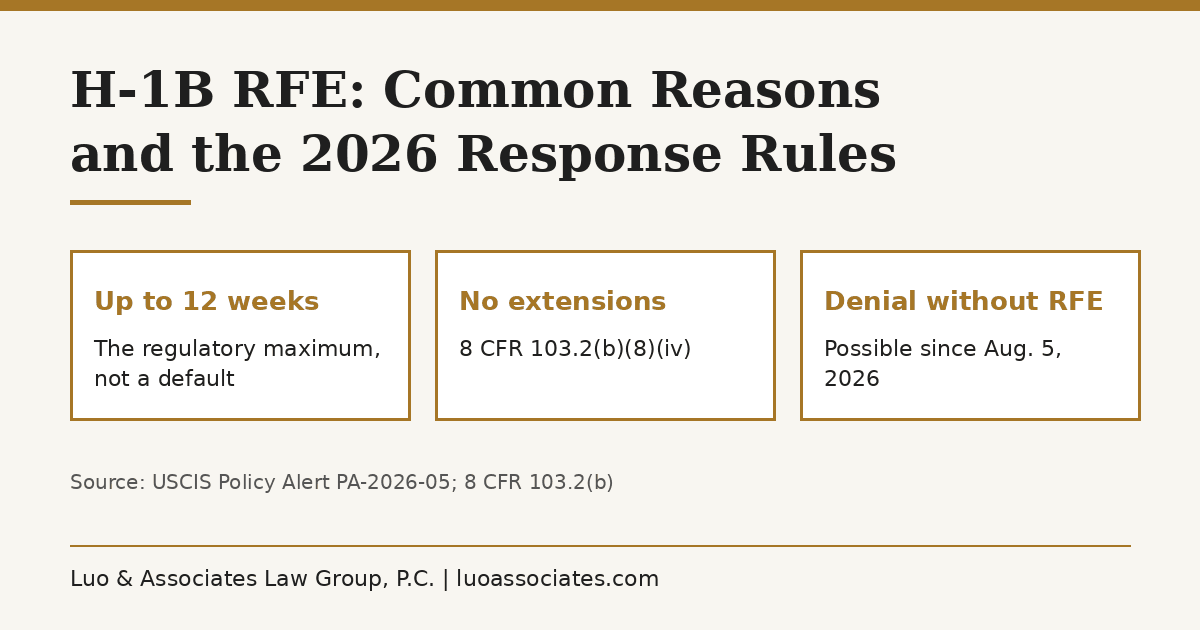
An H-1B RFE (Request for Evidence) means USCIS is not yet ready to approve the petition and wants more evidence first. It is not a denial. But since August 5, 2026, the rules around RFEs are stricter: the response period may be much shorter than the familiar 12 weeks, it cannot be extended, and USCIS may now deny a petition without sending an RFE at all.
Below I explain what changed, the most common reasons H-1B petitions receive RFEs, and how employers can respond.
What an RFE is
Under 8 CFR 103.2(b)(8), when the evidence filed with a petition does not establish eligibility, USCIS may deny the petition, request more evidence, or issue a Notice of Intent to Deny (NOID). The RFE lists what is missing and gives a deadline. The petition is decided on the record after the response, or after the deadline passes.
What changed on August 5, 2026
USCIS Policy Alert PA-2026-05 changed how officers issue RFEs and how much time petitioners get. It applies to cases pending on or filed after August 5, 2026. The main changes:
| Issue | Before August 5, 2026 | Now |
|---|---|---|
| RFE response period | Generally the full 12 weeks | Set case by case by the officer; 12 weeks is only the maximum |
| Extensions | Not available | Still not available: “Additional time to respond … may not be granted” (8 CFR 103.2(b)(8)(iv)) |
| Notices mailed abroad | 14 extra days | No extra time; only the 3 days added for service by mail (8 CFR 103.8(b)) |
| Missing initial evidence | Officers were generally instructed to issue an RFE or NOID first | USCIS may deny without first issuing an RFE or NOID |
| Partial responses | Treated as a request for a decision | Same, and the policy restates it: any partial response is a request for a decision on the record |
The practical result: a well-prepared initial filing matters more than ever, and an RFE deadline should be planned from the day the notice arrives. The date printed on the notice is the deadline that counts.
Five common reasons for H-1B RFEs
1. The position may not be a specialty occupation
This is the most frequent issue. Under 8 CFR 214.2(h)(4)(ii), a specialty occupation requires at least a bachelor’s degree in a directly related specific specialty. A position may accept a range of degree fields, but each must be directly related to the duties; a general degree without specialization is not enough. Useful evidence: a detailed description of duties and time spent on each, the degree requirement and why it is needed, and how comparable positions are staffed.
2. The wage level does not match the job description
When the Labor Condition Application lists an entry-level wage but the job description reads like a senior, complex role, the two can look inconsistent. The response needs to explain how the duties, the degree requirement and the wage level fit together. Where possible, I address this before filing rather than after an RFE.
3. Third-party worksites and whether the job offer is bona fide
Since January 17, 2025, the H-1B modernization rule requires the employer to have a bona fide job offer for the beneficiary, replacing the old “employer-employee relationship” test. At filing, the employer must show a bona fide specialty-occupation position as of the start date, but it does not need to show day-to-day assignments for the entire period. If the worker will be staffed to a third party, the third party’s requirements are what matter in deciding whether the position is a specialty occupation. Contracts, statements of work and a letter from the end client are the usual evidence.
4. The beneficiary’s qualifications
USCIS may question whether the worker’s degree is in a field directly related to the job, or whether a foreign degree is equivalent to a U.S. bachelor’s degree. Transcripts, a credential evaluation and detailed experience letters help. Under 8 CFR 214.2(h)(4)(iii)(D)(5), three years of specialized training or work experience may substitute for each year of college-level training the worker lacks.
5. Maintenance of status
For a change of status or extension inside the United States, USCIS checks whether the worker has maintained lawful status, including any F-1 OPT or STEM OPT period. Organize I-20s, EAD cards, I-94 records and prior approval notices into a clear timeline, and explain any gap in writing.
How to respond to an H-1B RFE
Under 8 CFR 103.2(b)(11), within the response period the petitioner may:
- Submit a complete response with all requested evidence at one time, together with the original RFE. This is almost always the right choice.
- Submit a partial response and ask for a decision on the record. Submitting only some of the requested evidence is treated this way automatically.
- Withdraw the petition.
If no response arrives by the deadline, USCIS may deny the petition as abandoned, on the record, or both (8 CFR 103.2(b)(13)). Because the response must reach USCIS by the deadline, plan to ship it at least several business days early.
Frequently asked questions
How long do I have to respond to an H-1B RFE?
Use the date printed on the notice. The regulation sets 12 weeks as the maximum; since August 5, 2026 the officer decides the period case by case, and 3 days are added for notices served by mail.
Can I ask USCIS for more time?
No. 8 CFR 103.2(b)(8)(iv) states that additional time to respond to an RFE or NOID may not be granted.
Does an RFE mean my H-1B will be denied?
No. An RFE means USCIS needs more evidence. A complete, well-organized response that addresses each point can still lead to an approval.
Can USCIS deny an H-1B petition without an RFE?
Yes. Under PA-2026-05, USCIS may deny a petition that lacks required initial evidence or does not establish eligibility without first issuing an RFE or NOID.
Related reading
- H-1B visa services
- Hiring an H-1B Transfer: Costs & Timeline for Employers
- H-1B Transfer vs. Amendment vs. Extension: How Do They Work?
If you have received an RFE or are preparing an H-1B petition, I personally review every case. Schedule a consultation.
Sources: USCIS Policy Alert PA-2026-05 (August 5, 2026); 8 CFR 103.2 and 8 CFR 214.2 (eCFR); Federal Register document 2024-29354 (December 18, 2024). This article is general information and is not legal advice.
About the Author

Wen Luo, JD, is the managing attorney of Luo & Associates Law Group, P.C. in New York, which she founded in 2018. She has more than 10 years of experience in U.S. immigration law and is a member of the American Immigration Lawyers Association (AILA).
Her practice focuses on employment-based immigration, including H-1B, L-1 (including L-1A/EB-1C for multinational companies), O-1, EB-1, EB-2 and EB-3 petitions, adjustment of status (I-485) and naturalization. She works with clients in English and Chinese.