
Reviewed by Wen Luo, immigration attorney, October 2026. Sources checked October 7, 2026.
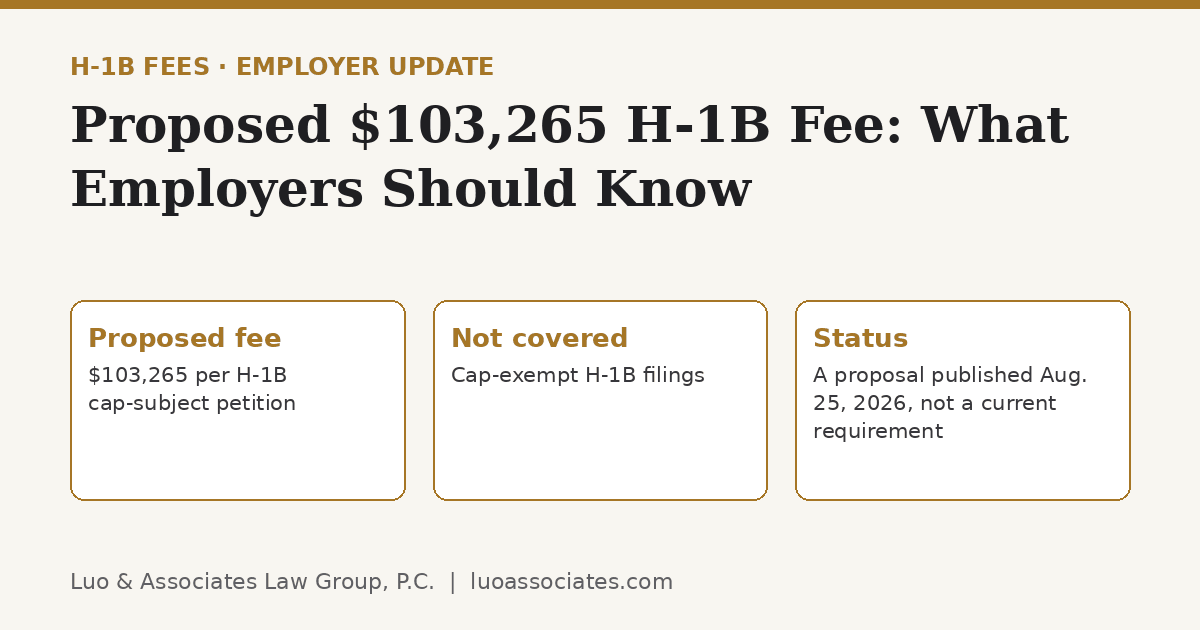
The $103,265 H-1B fee is a proposal, not a current requirement. DHS published the proposed rule on August 25, 2026, and the public comment period closed on September 24, 2026 (Federal Register, Fee for Certain H-1B Petitions). Employers do not pay it unless DHS publishes a final rule that requires it, and as of October 7, 2026 no final rule has been published.
What DHS proposed
- A $103,265 fee, paid at the time of filing, for all H-1B cap-subject petitions, including petitions under the U.S. master’s degree exemption.
- The fee would be in addition to all other filing fees and to any separate payment required by a presidential proclamation. An employer subject to both would pay both.
- It would not apply to cap-exempt H-1B filings.
- It would be added to the USCIS fee regulations as a new paragraph in 8 CFR 106.2(a)(3).
Source: DHS proposed rule, published August 25, 2026.
Which hires it would affect
| Situation | Would the proposed fee apply? |
|---|---|
| New hire selected in the H-1B registration (regular cap) | Yes, if finalized |
| New hire under the U.S. master’s degree cap | Yes, if finalized |
| Cap-exempt petition | No |
| Petition that is not cap-subject, such as many extensions and changes of employer for workers already counted against the cap | In my reading, no, because the proposal covers only cap-subject petitions. Confirm against the final rule |
How it relates to the $100,000 proclamation payment
The proposed fee is separate from the $100,000 payment tied to the September 19, 2025 presidential proclamation. USCIS reports that on June 8, 2026 a federal district court vacated the agency guidance implementing the $100,000 payment, and that on July 24, 2026 the First Circuit denied the government’s motion to stay that order. USCIS says DHS will comply with the court’s order while it considers next steps, and that it still plans to collect the payment if the order is lifted (USCIS, H-1B Specialty Occupations).
What already changed on September 9, 2026
A separate final rule on the 9-11 Response and Biometric Entry-Exit Fee took effect on September 9, 2026. Covered employers, meaning those with 50 or more employees in the United States where more than 50 percent are in H-1B, L-1A or L-1B status, now pay that fee on all extension petitions, including extensions that do not involve a change of employer (Federal Register, final rule). Check current amounts in the USCIS fee schedule (Form G-1055).
Another proposal to watch: the 60-day grace period
On September 11, 2026, DHS also proposed removing the up-to-60-day grace period in 8 CFR 214.1(l)(2) that workers in E, H-1B, H-1B1, L-1, O-1 and TN status can receive after their employment ends. Comments are due by November 10, 2026 (Federal Register, Eliminating the Discretionary 60-Day Grace Period). If it is finalized, layoffs and job changes would need to be planned more carefully.
What I suggest employers do now
- Separate your H-1B plans into cap-subject new hires and other filings, such as transfers and extensions. The proposal only targets the first group.
- Build two budget scenarios for the next registration season: with and without the proposed fee.
- Do not pay or reserve any amount based on the proposal alone. Watch the Federal Register for a final rule and its effective date.
- If the grace period proposal matters to your workforce, you can submit a comment by November 10, 2026.
Frequently asked questions
Do we have to pay $103,265 now?
No. It is a proposed rule. Nothing is owed unless a final rule is published and takes effect.
Would it apply to an H-1B transfer?
The proposal applies to cap-subject petitions. Many transfers are filed for workers already counted against the cap, which in my reading would put them outside the proposal, but the final rule controls.
Is this the same as the $100,000 payment?
No. The $100,000 payment comes from a presidential proclamation and is currently affected by a court order, as USCIS explains on its H-1B page. The $103,265 amount is a proposed USCIS fee and would be in addition to any proclamation payment.
Plan your next H-1B hires
I personally review every case, supported by our paralegal team. See my H-1B services, read hiring an H-1B transfer: costs and timeline, or book a free consultation.
This article is general information, not legal advice for your situation. Rules in this area are changing; check the sources linked above for the latest status.
About the Author

Wen Luo, JD, is the managing attorney of Luo & Associates Law Group, P.C. in New York, which she founded in 2018. She has more than 10 years of experience in U.S. immigration law and is a member of the American Immigration Lawyers Association (AILA).
Her practice focuses on employment-based immigration, including H-1B, L-1 (including L-1A/EB-1C for multinational companies), O-1, EB-1, EB-2 and EB-3 petitions, adjustment of status (I-485) and naturalization. She works with clients in English and Chinese.