
Reviewed by Wen Luo, immigration attorney, October 2026.
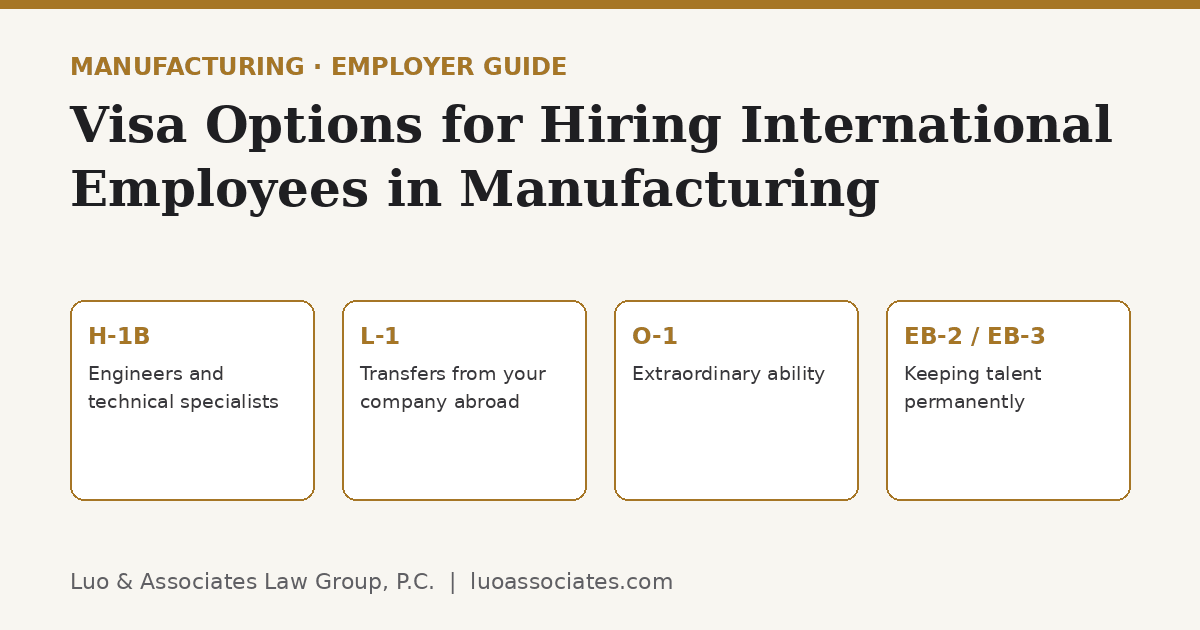
Manufacturers hiring engineers and other technical specialists from abroad usually start with the H-1B. If the candidate already works for your company overseas, the L-1 can avoid the H-1B lottery, and for long-term hires an employment-based green card (EB-2 or EB-3) is the permanent option. The right choice depends on the role, the candidate’s background and how your company is structured.
Which visa fits which manufacturing role
| Situation | Usual option | Key point |
|---|---|---|
| Engineer or technical specialist with a related bachelor’s degree | H-1B | The job must be a specialty occupation; new hires usually go through the annual cap and lottery |
| Manager, executive or specialized-knowledge employee from your company abroad | L-1 | Requires a qualifying relationship between the companies and one continuous year of employment abroad in the last three years |
| Engineer or researcher with major recognition in the field | O-1 | Reserved for individuals with extraordinary ability |
| Long-term employee you want to keep permanently | EB-2 or EB-3 green card | EB-3 petitions usually require an approved labor certification from the Department of Labor |
H-1B: engineering and other technical roles
The H-1B covers specialty occupations: jobs that require the theoretical and practical application of highly specialized knowledge and at least a bachelor’s degree in a directly related specialty, or its equivalent (8 CFR 214.2(h)(4)(ii)). A position is not a specialty occupation if a general degree, without further specialization, is enough.
In manufacturing, roles such as mechanical, electrical, industrial, process and quality engineers often fit, but it depends on the actual duties and the degree the job requires. I look closely at the job description before filing, because a description that reads like a general production role is a common problem.
New H-1B employment is subject to an annual cap of 65,000, plus 20,000 for beneficiaries with a U.S. master’s degree or higher (USCIS, H-1B Specialty Occupations). In practice that means planning around the annual H-1B registration period, not the date you want the person to start.
The $100,000 payment: USCIS reports that a federal court vacated the agency guidance implementing the $100,000 payment for certain H-1B petitions, and that DHS will comply with the court’s order while it considers next steps (USCIS, checked October 5, 2026). Check the current status on that page before you budget a new H-1B hire.
L-1: transfers from your own facilities abroad
If you have a parent, subsidiary, affiliate or branch abroad, the L-1 lets you transfer a manager, executive or specialized-knowledge employee to a U.S. facility. The employee must have worked for the company abroad for one continuous year within the three years before filing (USCIS, L-1A). L-1 petitions do not go through the H-1B registration and lottery. If the U.S. operation is new, the stricter new office rules apply; see my guide to L-1A new office petitions.
O-1: individuals with extraordinary ability
The O-1 is for people with extraordinary ability, for example an engineer whose work has been widely recognized in the field. It is not a general hiring route, but it can fit a senior specialist. See my O-1 visa services.
EB-2 and EB-3: keeping talent long term
For employees you want to keep, an employment-based green card is the permanent option. EB-3 covers skilled workers (jobs requiring at least two years of training or experience), professionals and other workers, and EB-3 petitions are usually accompanied by an approved Form ETA-9089 labor certification (USCIS, EB-3). Labor certification is a multi-step process with the Department of Labor, so start early. See EB-2 and EB-3 green cards.
Timing and costs
- Premium processing: for most classifications, USCIS takes action within 15 business days of accepting a premium processing request, for an additional fee (USCIS). That speeds the decision, not the H-1B lottery calendar.
- Government filing fees depend on the form, the visa type and, for some fees, company size. Use the current USCIS fee schedule (Form G-1055); USCIS notes that a new fee rule applies to filings postmarked on or after September 9, 2026.
- My fee for H-1B legal services is a flat $2,999, separate from government fees. See fees.
Frequently asked questions
Does a small manufacturer need a minimum number of employees to sponsor an H-1B?
The core question for USCIS is whether the job is a specialty occupation and whether the petition meets the H-1B requirements. I review company size, finances and the job itself during the consultation, because a small company should expect closer questions about the role.
Can a production or line worker get an H-1B?
Usually not. A position that does not require a bachelor’s degree in a specific specialty is not a specialty occupation (8 CFR 214.2(h)(4)(ii)). For those roles, EB-3 may be worth discussing.
When should we start?
For a new H-1B hire, start well before the annual H-1B registration period. For L-1 and green card cases, start as soon as you know who you want to bring over or keep.
Talk to me about your hiring plans
I personally review every case, supported by our paralegal team. See my H-1B services, read hiring an H-1B transfer: costs and timeline, or book a free consultation.
This article is general information, not legal advice for your situation.
About the Author

Wen Luo, JD, is the managing attorney of Luo & Associates Law Group, P.C. in New York, which she founded in 2018. She has more than 10 years of experience in U.S. immigration law and is a member of the American Immigration Lawyers Association (AILA).
Her practice focuses on employment-based immigration, including H-1B, L-1 (including L-1A/EB-1C for multinational companies), O-1, EB-1, EB-2 and EB-3 petitions, adjustment of status (I-485) and naturalization. She works with clients in English and Chinese.