
Reviewed by Wen Luo, immigration attorney, October 2026.
If your company abroad wants to send a manager or executive to open its first U.S. office, the L-1A “new office” rules apply. USCIS limits the first approval to one year, and to extend it you must show that the U.S. office has actually been doing business for that year. Planning for that one-year review from day one is the most important part of these cases.
What counts as a “new office”
Under the regulations, a new office is an organization that has been doing business in the United States through a parent, branch, affiliate or subsidiary for less than one year (8 CFR 214.2(l)(1)(ii)(F)). If your U.S. entity was formed recently, or has existed on paper but has not been operating, plan on the new office rules.
What you file at the start
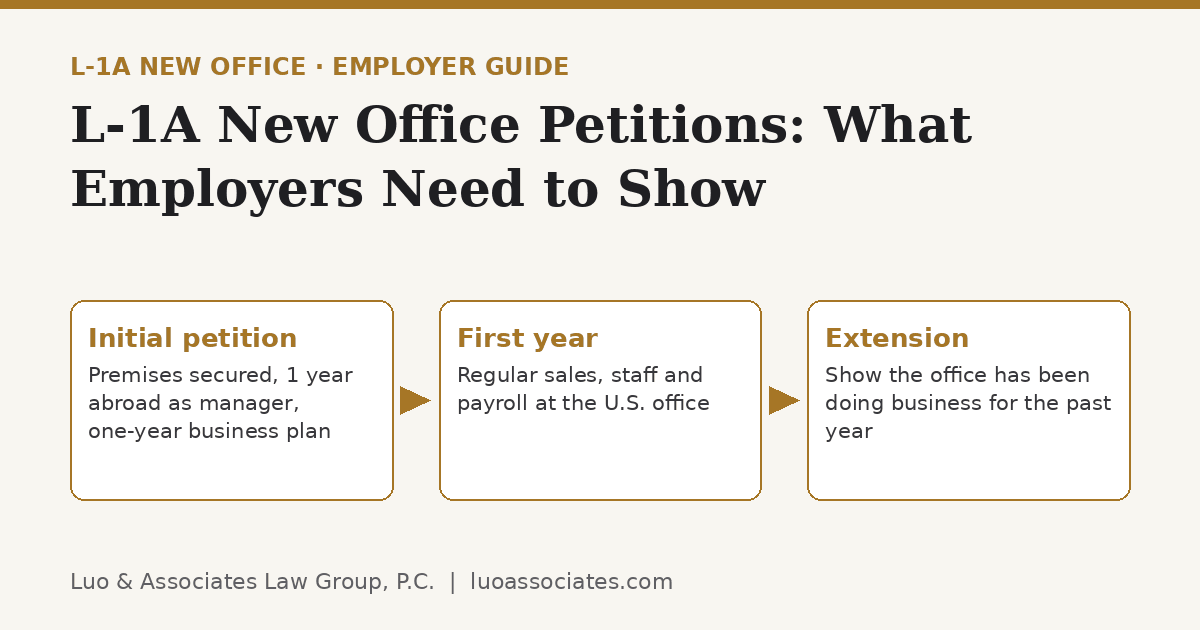
On top of the usual L-1 requirements, a petition for a manager or executive coming to open or work in a new office must include evidence that (8 CFR 214.2(l)(3)(v)):
- Premises: sufficient physical premises to house the new office have been secured.
- Prior employment: the employee has worked for the company abroad for one continuous year in the three years before filing, in an executive or managerial capacity, and the U.S. role involves executive or managerial authority over the new operation.
- A credible one-year plan: the U.S. operation will support an executive or managerial position within one year of approval, shown by the nature of the office (scope, organizational structure, financial goals), the size of the U.S. investment and the foreign company’s financial ability to pay the employee and start doing business, and the foreign company’s organizational structure.
In my practice, the lease and the business plan are where I spend the most time. The premises should fit the business you describe, and the plan should show who will be hired in the first year so that the employee can move from setting up the office to managing it.
How long the first approval lasts
An employee coming to establish a new office is allowed a maximum initial stay of one year; other L-1A employees can receive up to three years (USCIS, L-1A Intracompany Transferee Executive or Manager; 8 CFR 214.2(l)(7)(i)(A)(3)).
What you need for the one-year extension
To extend a new office petition, the employer files a new petition with (8 CFR 214.2(l)(14)(ii)):
- Evidence that the U.S. and foreign companies are still qualifying organizations;
- Evidence that the U.S. company has been doing business for the previous year;
- A statement of the duties the employee performed during the year and will perform under the extension;
- A statement describing the staffing of the new operation, including the number of employees and types of positions, with evidence of wages paid when the employee will work as a manager or executive; and
- Evidence of the financial status of the U.S. operation.
“Doing business” means the regular, systematic and continuous provision of goods or services; the mere presence of an agent or office does not count (8 CFR 214.2(l)(1)(ii)(H)). A U.S. office that has a lease and a bank account but no customers, invoices or payroll will have a hard time at this stage.
Start vs. renewal at a glance
| Initial new office petition | One-year extension | |
|---|---|---|
| Office | Premises secured | Office has been doing business for the past year |
| Employee | 1 continuous year abroad as manager/executive in the last 3 years | Statement of duties performed and duties going forward |
| Business | Plan: scope, structure, financial goals, U.S. investment | Staffing, wages paid, financial status of the U.S. operation |
| Approval period | Up to 1 year | Extensions in increments of up to 2 years, up to the 7-year L-1A maximum |
What I recommend employers track during the first year
- Signed contracts, invoices and bank records that show regular sales of goods or services.
- Payroll records and an organizational chart that show who reports to the L-1A employee.
- Financial statements for the U.S. company.
- A short log of the employee’s actual duties, so the extension describes managerial or executive work rather than day-to-day tasks.
Frequently asked questions
Can a specialized knowledge (L-1B) employee open a new office?
Yes, but the employer must show secured premises, that the U.S. business is or will be a qualifying organization, and that it can pay the employee and begin doing business (8 CFR 214.2(l)(3)(vi)).
Can the employee’s family come?
Yes. A spouse and unmarried children under 21 may seek L-2 status and generally receive the same period of stay as the employee (USCIS).
How long can an L-1A manager stay in total?
After the first approval, L-1A extensions may be granted in increments of up to two years, up to a maximum of seven years (USCIS).
Talk to me about your U.S. expansion
I personally review every L-1 case, supported by our paralegal team. If your company is planning a first U.S. office, see my L-1 visa services or book a consultation. For what to do once a visa is approved, see practical next steps for new H-1B, L-1 and O-1 holders.
This article is general information, not legal advice for your situation.
About the Author

Wen Luo, JD, is the managing attorney of Luo & Associates Law Group, P.C. in New York, which she founded in 2018. She has more than 10 years of experience in U.S. immigration law and is a member of the American Immigration Lawyers Association (AILA).
Her practice focuses on employment-based immigration, including H-1B, L-1 (including L-1A/EB-1C for multinational companies), O-1, EB-1, EB-2 and EB-3 petitions, adjustment of status (I-485) and naturalization. She works with clients in English and Chinese.