
Reviewed by Wen Luo, immigration attorney, October 2026. Sources checked October 7, 2026.
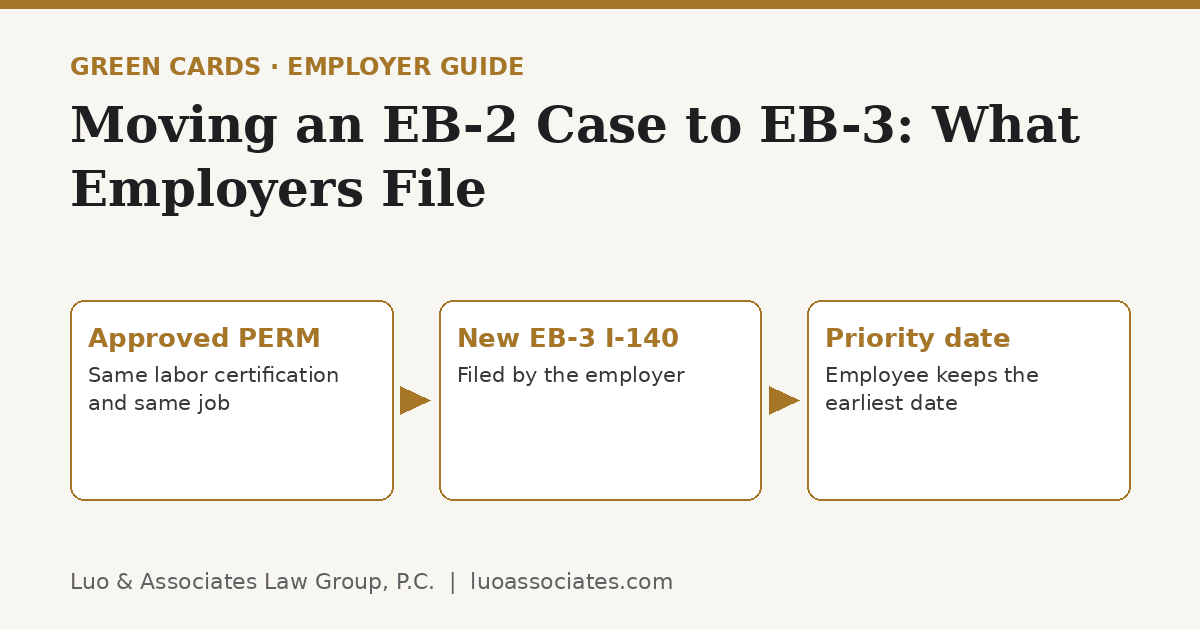
An EB-2 “downgrade” means the employer files a new Form I-140 in the EB-3 category using the same approved PERM labor certification. The employee keeps the earliest priority date from the approved petitions (8 CFR 204.5(e)(1)), so they can use whichever category becomes available first. The EB-2 petition does not have to be withdrawn.
When it is worth considering
It makes sense when the EB-3 date for the employee’s country of birth is ahead of the EB-2 date. Each month USCIS says which Visa Bulletin chart to use for employment-based adjustment filings; for October 2026 it is the Dates for Filing chart (USCIS, Adjustment of Status Filing Charts). Dates move every month, so check the current chart before deciding.
It usually does not help when EB-2 is already current for the employee, or when the PERM job requirements would not fit EB-3.
What the employer files
- A new Form I-140 in EB-3, as a professional (at least a U.S. bachelor’s degree or foreign equivalent) or a skilled worker (a job requiring at least two years of training or experience) (8 CFR 204.5(l)(2)).
- The same labor certification. The original must normally be submitted with an I-140 unless it has already been filed with another petition. USCIS accepts a petition requesting a different immigrant classification with a copy of the labor certification, even after the certification’s validity period, if the original was submitted with an earlier petition while it was valid (USCIS Policy Manual, Vol. 6, Part E, Ch. 6).
- The usual I-140 evidence for EB-3 and the current filing fee from the USCIS fee schedule.
Keeping the EB-2 priority date
An approved EB-1, EB-2 or EB-3 petition gives the employee its priority date for any later petition in those categories, and with several approved petitions the employee gets the earliest date (8 CFR 204.5(e)(1)). The date is lost only if USCIS revokes the earlier approval for fraud or willful misrepresentation, revocation or invalidation of the labor certification, or material error (8 CFR 204.5(e)(2)).
If an I-485 is already pending
An employee with a pending adjustment application can ask USCIS to transfer it to the new EB-3 petition instead of filing a new I-485. The request is discretionary, must come with evidence of eligibility under the new category, and should be made well before USCIS decides the case. Once granted, the original petition no longer supports the I-485 (USCIS Policy Manual, Vol. 7, Part A, Ch. 8).
EB-2 and EB-3 side by side
| Keep EB-2 only | Add an EB-3 petition | |
|---|---|---|
| Labor certification | Already used | Same certification (copy allowed in this situation) |
| Priority date | Original date | Original date retained |
| Employer filing | None | New Form I-140 and fee |
| Pending I-485 | Stays on EB-2 | Can request a transfer to EB-3 |
Frequently asked questions
Does the employee give up EB-2?
No. Both petitions can stay approved, and the employee can move forward under whichever category becomes available first.
Does the job have to change?
No. The EB-3 petition uses the same approved labor certification and the same job. The question is whether the employee and the job meet the EB-3 definitions.
Who pays?
The employer files the I-140. I discuss fee arrangements with both the employer and the employee at the start.
Talk to me about your green card cases
I personally review every case, supported by our paralegal team. See EB-2 and EB-3 green cards or book a free consultation.
This article is general information, not legal advice for your situation.
About the Author

Wen Luo, JD, is the managing attorney of Luo & Associates Law Group, P.C. in New York, which she founded in 2018. She has more than 10 years of experience in U.S. immigration law and is a member of the American Immigration Lawyers Association (AILA).
Her practice focuses on employment-based immigration, including H-1B, L-1 (including L-1A/EB-1C for multinational companies), O-1, EB-1, EB-2 and EB-3 petitions, adjustment of status (I-485) and naturalization. She works with clients in English and Chinese.